

Key Challenges in Modern Shipbuilding and How Technology is Solving Them
The shipbuilding industry plays a vital role in global trade, defence, and maritime infrastructure. However, modern shipbuilders face increasing challenges such as rising costs, complex engineering requirements, and strict regulatory compliance. Companies like Navsys Marine Technologies Pvt. Ltd. are addressing these challenges through advanced manufacturing, innovation, and high-quality engineering solutions.
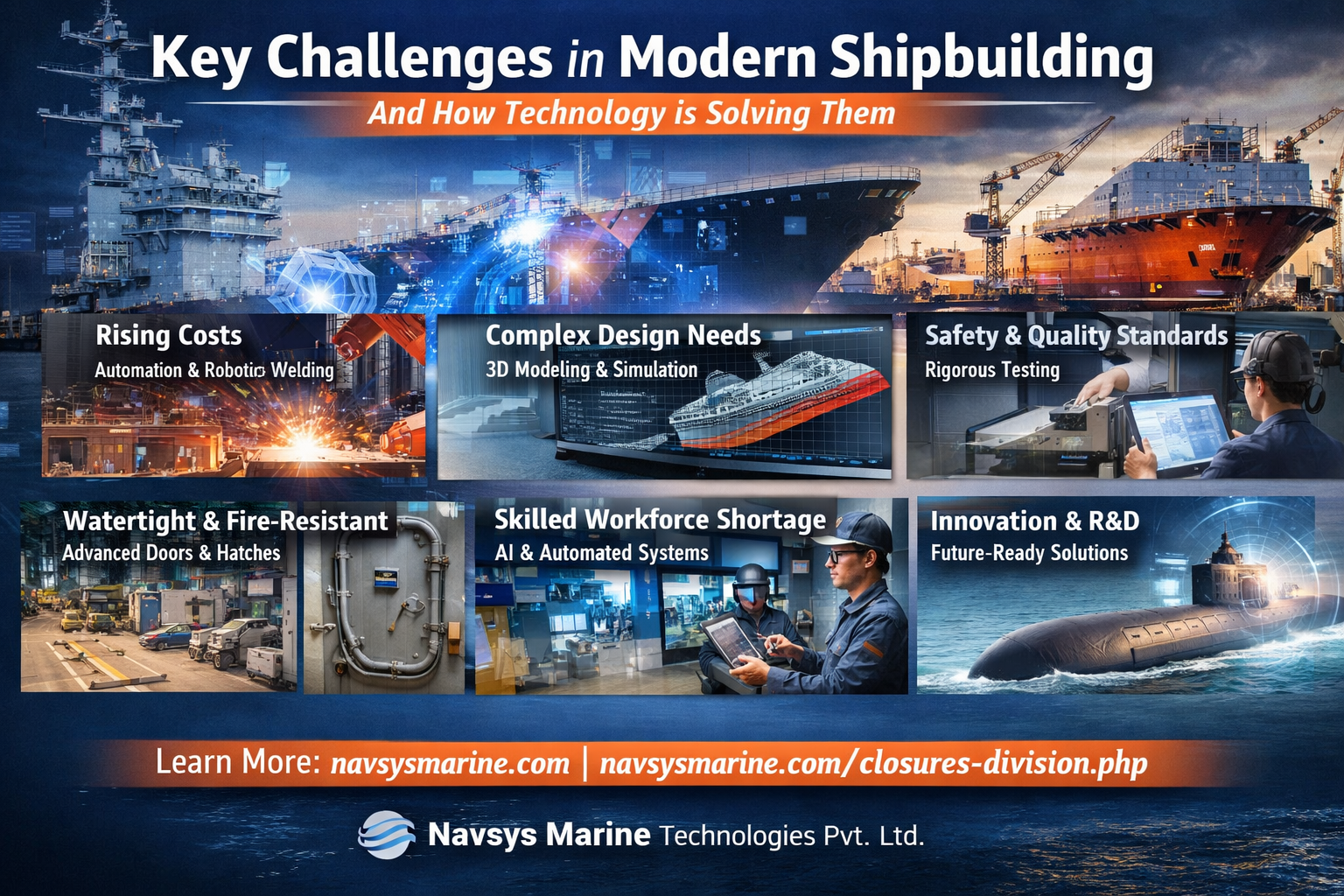
- Rising Construction Costs
Challenge:
Shipbuilding projects demand significant investment in materials, labour, and infrastructure. Price fluctuations in raw materials like steel further increase financial pressure.
Solution:
Modern shipyards are adopting automation, robotic welding, and CNC machining to reduce labour dependency and improve precision. Companies like Navsys Marine Technologies Pvt. Ltd. leverage advanced in-house manufacturing technologies such as robotic welding and laser cutting to optimize production efficiency and cost control.
- Complex Design and Engineering Requirements
Challenge:
Today’s vessels require highly sophisticated designs to meet performance, durability, and safety standards.
Solution:
Technologies like CFD (Computational Fluid Dynamics), FEM analysis, and 3D modelling help engineers simulate real-world conditions before construction. Navsys Marine Technologies Pvt. Ltd. uses advanced simulation and rapid prototyping (including 3D printing) to ensure accurate and efficient design development.
- Stringent Safety and Quality Standards
Challenge:
Shipbuilding, especially for defence and naval applications, requires compliance with strict international standards such as IMO, SOLAS, and classification societies.
Solution:
Modern manufacturers implement rigorous testing and certified processes. At Navsys Marine Technologies Pvt. Ltd., products undergo structural, environmental, and functional testing to meet global naval standards, ensuring reliability in extreme maritime conditions.
- Specialized Components and Closures Systems
Challenge:
Critical ship components like watertight doors, hatches, and closures must meet high-performance and safety requirements, especially in naval vessels.
Solution:
Dedicated divisions focus on specialized products. For instance, the Closure Division at Navsys Marine develops advanced watertight, gastight, and fire-rated doors and hatches designed for harsh marine environments. These systems enhance vessel safety, durability, and compliance with Défense standards
- Skilled Workforce Shortage
Challenge:
The industry faces a shortage of skilled professionals in welding, fabrication, and advanced engineering.
Solution:
Automation, AI-driven tools, and modern training systems reduce dependency on manual skills. Advanced manufacturing facilities like the 70,000 sq. ft. integrated unit of Navsys Marine Technologies Pvt. Ltd. enable efficient production with fewer human errors.
- Supply Chain and Project Delays
Challenge:
Global supply chain disruptions and coordination issues can delay shipbuilding projects.
Solution:
End-to-end in-house manufacturing capabilities ensure better control over production timelines. Navsys Marine Technologies Pvt. Ltd. maintains complete control from design to delivery, improving speed, precision, and reliability.
- Innovation and Future Readiness
Challenge:
Keeping up with rapid technological advancements and evolving defence requirements is a constant challenge.
Solution:
Continuous R&D and innovation are key. With dedicated research teams, advanced materials, and cutting-edge engineering, Navsys Marine Technologies Pvt. Ltd. is contributing to the development of future-ready marine systems for both surface and sub-surface platforms.
Conclusion
Modern shipbuilding is undergoing a technological transformation. While challenges such as cost, complexity, and compliance remain significant, innovative solutions are reshaping the industry. Companies like Navsys Marine Technologies Pvt. Ltd. are leading this evolution with advanced manufacturing, specialized divisions, and strong R&D capabilities.
By integrating automation, simulation, and high-quality engineering, the future of shipbuilding is becoming more efficient, reliable, and sustainable ready to meet the demands of global maritime and defence sectors.